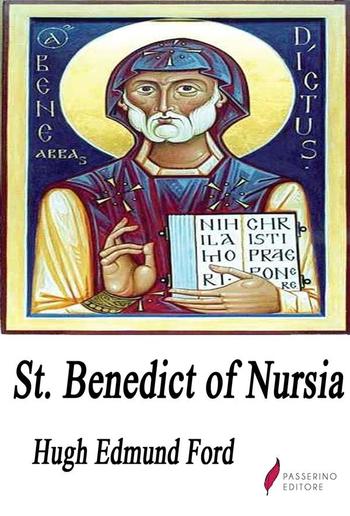
Hugh Edmund Ford - St. Benedict of Nursia
St. Benedict of Nursia
Hugh Edmund Ford


Mô tả
Benedict of Nursia (c. 2 March 480 – c. 21 March 543 AD) is a Christian saint venerated in the Catholic Church, the Eastern Orthodox Church, the Oriental Orthodox Churches, the Anglican Communion and Old Catholic Churches. He is a patron saint of Europe.
Benedict founded twelve communities for monks at Subiaco, Lazio, Italy (about 65 kilometres (40 mi) to the east of Rome), before moving to Monte Cassino in the mountains of southern Italy. The Order of Saint Benedict is of later origin and, moreover, not an "order" as commonly understood but merely a confederation of autonomous congregations.
Benedict's main achievement, his "Rule of Saint Benedict", contains a set of rules for his monks to follow. Heavily influenced by the writings of John Cassian, it shows strong affinity with the Rule of the Master, but it also has a unique spirit of balance, moderation and reasonableness (ἐπιείκεια, epieíkeia), which persuaded most Christian religious communities founded throughout the Middle Ages to adopt it. As a result, his Rule became one of the most influential religious rules in Western Christendom. For this reason, Giuseppe Carletti regarded Benedict as the founder of Western Christian monasticism.
Hugh Edmund Ford